 Hakan Çelik
More Accurate Meta Classes Without Type
More Accurate Meta Classes Without Type
In the previous post we implemented the basic metaclass protocol without deriving from type. This time we have a more complete version: __call__ manages a two-phase lifecycle, and __str__ along with all attribute/item operations are delegated to the namespace.
class Meta:
    def __prepare__(name, bases, **kwargs):
        return dict()

    def __new__(cls, name, bases, namespace, **kwargs):
        obj = object.__new__(cls)

        obj.__init__(name, bases, namespace, **kwargs)
        return obj

    def __init__(self, name, bases, namespace, **kwargs):
        self.name = name
        self.bases = bases
        self.namespace = namespace
        self.kwargs = kwargs

        self.__call_run = False

    def __call__(self, *args, **kwargs):
        if not self.__call_run:
            self.__call_run = True

            cls_new = self.namespace["__new__"]
            cls_init = self.namespace["__init__"]

            obj = cls_new(self, *args, **kwargs)
            cls_init(obj, *args, **kwargs)
        else:
            cls_call = self.namespace["__call__"]
            obj = cls_call(self, *args, **kwargs)

        return obj

    def __str__(self):
        if not self.__call_run:
            return "<Meta: {}>".format(self.name)
        else:
            return self.namespace["__str__"](self)

    def __repr__(self):
        return self.__str__()

    def __getattribute__(self, name):
        return object.__getattribute__(self, name)

    def __setattr__(self, name, value):
        object.__setattr__(self, name, value)

    def __delattr__(self, name):
        object.__delattr__(self, name)

    def __getitem__(self, key):
        return self.namespace[key]

    def __setitem__(self, key, value):
        self.namespace[key] = value

    def __delitem__(self, key):
        del self.namespace[key]

    def __len__(self):
        return len(self.namespace)

    def __contains__(self, item):
        return item in self.namespace

    def __iter__(self):
        return iter(self.namespace)

    def __reversed__(self):
        return reversed(self.namespace)

class Klass(metaclass=Meta):
    def __new__(cls, *args, **kwargs):
        return cls

    def __init__(self, *args, **kwargs):
        pass

    def __call__(self, *args, **kwargs):
        return self

    def __str__(self):
        return "<Klass: {}>".format(self.name)

klass = Klass(1, a=1)
klass(deneme=3)

print(klass)
Two-Phase Lifecycle
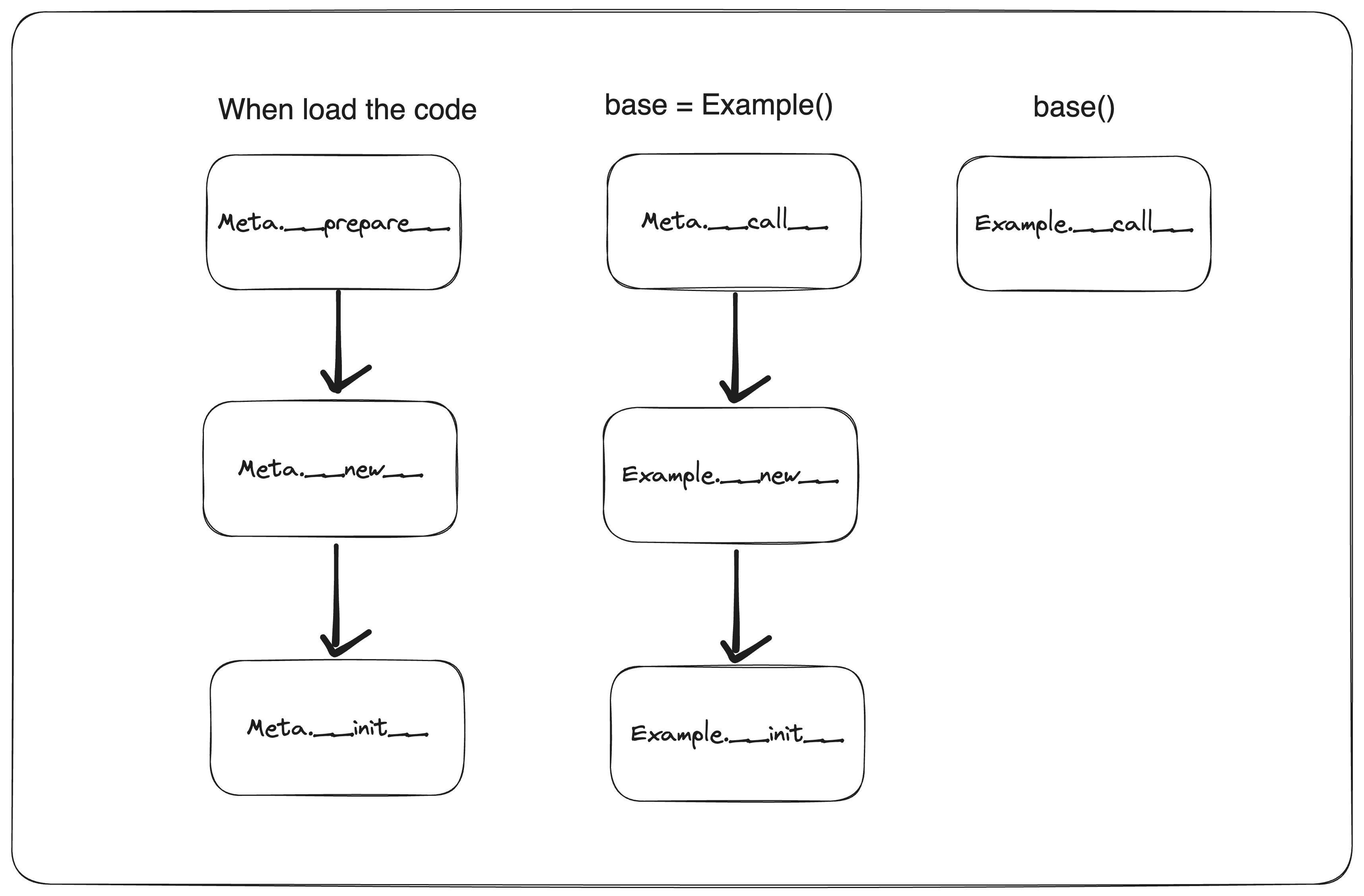
A Meta instance (i.e., Klass) is called in two different ways; the __call_run flag distinguishes these two phases:
Phase 1 — klass = Klass(1, a=1) (first call, __call_run = False)
Meta.__call__ takes over:
- Because
__call_runis False, it runs__new__and__init__from the class body Klass.__new__(self, 1, a=1)→return cls→obj = Klass’s Meta instanceKlass.__init__(obj, 1, a=1)→pass- Marks
__call_run = True - Returns
obj→klassis the Meta instance ofKlassitself
Phase 2 — klass(deneme=3) (subsequent call, __call_run = True)
Meta.__call__ takes over again:
- Because
__call_runis True, it fetches__call__from the namespace and runs it Klass.__call__(self, deneme=3)→return self
print(klass) → <Klass: Klass>
Meta.__str__ is called; since __call_run = True, it delegates to __str__ in the namespace: Klass.__str__(klass) → "<Klass: {}>".format(self.name) → self.name = "Klass" (stored in Meta.__init__).
Why Is __prepare__ Not a classmethod?
In this implementation __prepare__ is defined as a plain function. Python performs a special lookup on __prepare__ and calls it directly; it is not required to be a classmethod. As a result, the name and bases arguments arrive as the first and second parameters — without cls/mcs.