 Hakan Çelik
Understanding Python Classes
Understanding Python Classes
In Python, everything is an object and every object has a type. This rule applies to primitives just as it applies to classes themselves. The type() function or the .__class__ attribute returns the type of any object; the two always produce the same result.
class Example:
	attr = 1

	def method(self):
		return "method"

print(f"{type(44)=}")              # type(44)=<class 'int'>
print(f"{type('hello')=}")         # type('hello')=<class 'str'>
print(f"{type(())=}")              # type(())=<class 'tuple'>
print(f"{type([])=}")              # type([])=<class 'list'>

print(f"{Example.__class__=}")     # <class 'type'>
print(f"{type(Example)=}")         # <class 'type'>
print(f"{type(type(type))=}")      # <class 'type'>

print(f"{Example().__class__=}")   # <class '__main__.Example'>

assert isinstance(Example, type)
assert isinstance(Example(), Example)
What Does the Output Tell Us?
The first four lines show what we expect: 44 is an int, 'hello' is a str.
The truly interesting part is the three lines in the middle:
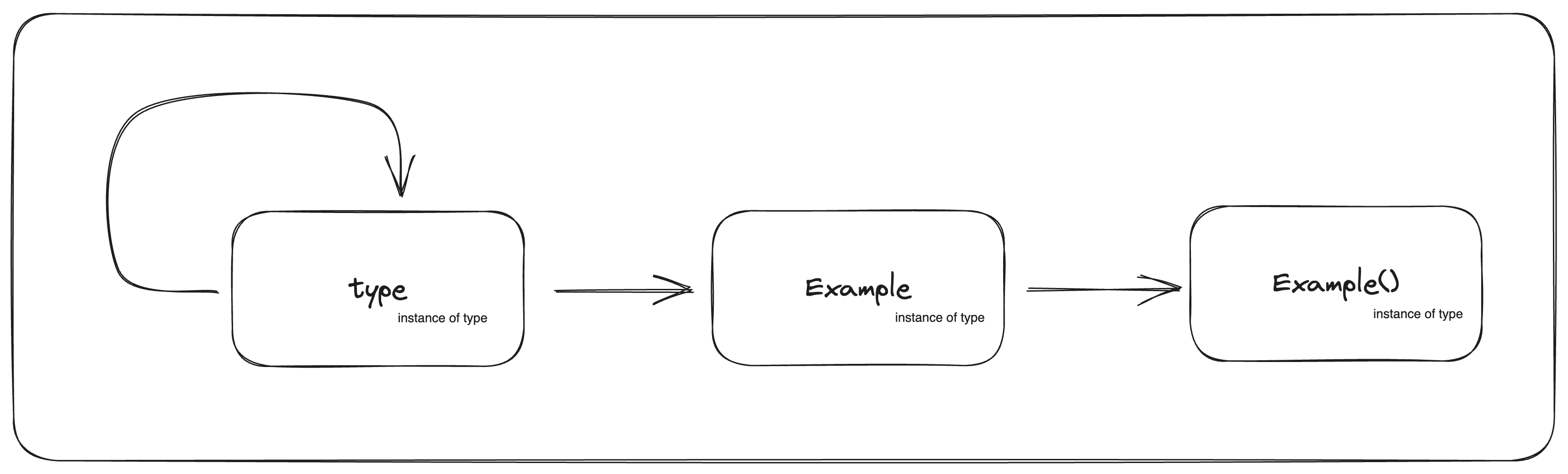
Example.__class__→<class 'type'>— theExampleclass itself is an instance oftype. Classes are also objects; the type of these objects istype.type(Example)→ same result; usingtype()and.__class__are equivalent.type(type(type))→ still<class 'type'>—typeis its own metaclass; its type is itself.
The last line completes the picture: Example().__class__ → <class '__main__.Example'>. An instance created from a class returns its own class as its type — the same logic as with ordinary objects.
The assert Lines
assert isinstance(Example, type)    # Classes are instances of type
assert isinstance(Example(), Example)  # Instances are instances of their own class
These two rules are the foundation of Python’s object model. type sits at the top of the metaclass hierarchy; all classes — whether we are aware of it or not — are instances of type.